Hamam guides
Does a Turkish bath remove your tan?
A full-body scrub near the end of a beach holiday can look like a threat to the colour you have built up. What the kese actually reaches is narrower than that.
Last updated November 7, 2026 · Murat Atalay Travel Agency, TÜRSAB No. 11294
Short answer
A natural sun tan stays. The kese takes off dead cells from the very top of the skin; the brown of a tan is pigment made further down, at the base of the skin's outer layer, so the scrub does not strip it. Self-tan is different: it colours the surface itself, so the kese can take some of it off. And if you are sunburned, the kese should wait.
What the kese reaches
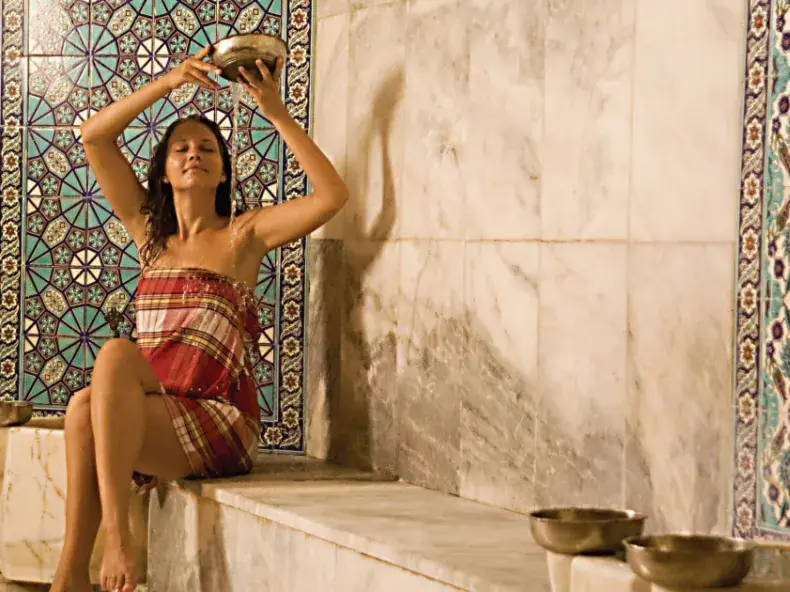
In the Basic Hamam an attendant scrubs you all over on the heated marble with a kese, a mitt of coarse woven cloth. That is exfoliation, and the American Academy of Dermatology describes exfoliation as removing dead skin cells from the outer layer of the skin. Our page on kese and foam describes the scrub itself; this page is only about what it means for your skin colour.
Why a sun tan is not scrubbed off
A tan is melanin. It is made by pigment cells, melanocytes, that sit in the deepest layer of the epidermis, and passed from there to the skin cells around them — it is not a coating lying on top. A scrub that lifts dead cells from the surface does not reach the place where that pigment is produced.
A tan still fades in its own time, as skin renews itself, hamam or no hamam. We make no promise about your colour either way: the hamam is not a tanning treatment, and it is not sold as one.
Self-tan: the exception
Self-tanning products work differently. According to the US Food and Drug Administration, their active ingredient, DHA, darkens the skin by reacting with the skin's surface — the same layer the kese works on. So a scrub can take part of a self-tan off, and what remains may look uneven.
The American Academy of Dermatology advises exfoliating before you apply a self-tanner, not after. If you use one on holiday, the simple order is hamam first, self-tan afterwards. A self-tan colour is not sun protection either, unless the product has an SPF: you still need sunscreen.
First day of the holiday or last?
| Your situation | What that means for the day |
|---|---|
| A natural tan only | Any day suits: the kese does not scrub the tan off |
| You use self-tan | Go before you apply it, as early in the stay as you like |
| Sunburned skin | Not while it is burned — move the date or cancel in time |
| Flying home the next day | Possible; keep about 2.5–3 hours free, transfers included |
Online bookings start from tomorrow's date. Your pickup time is confirmed before the day, so keep that half-day flexible until it arrives.
If you are sunburned
The American Academy of Dermatology is clear: never exfoliate skin that is sunburned, or over cuts and open wounds. A full-body kese is a firm scrub, so do not have it on burned skin.
If a burn comes up before your hamam day, tell us. Up to 48 hours ahead a cancellation costs nothing, and to move the date, message us on WhatsApp and we will check. Tell the hamam about the burn before your session, too.
What one small study found
One research team tested whether skin burns more easily after a hamam scrub. In twelve healthy adults with fair to medium skin, one side of the back was scrubbed in the hamam way and the other left alone, followed by 30 minutes of sun. Over the next 24 hours, the scrubbed side did not turn measurably redder or sorer than the untouched one.
It is one study, with twelve people, one short spell of sun and only fair to medium skin types. It is reassuring, not a guarantee: after the hamam, protect your skin from the sun exactly as you would on any other day.
Darker or sensitive skin
- The American Academy of Dermatology notes that strong exfoliation can leave dark marks on some skin, especially darker skin tones. If the scrub feels too hard, say so straight away.
- Over-exfoliating can leave skin red and irritated. One kese in a holiday is not a daily routine, but if your skin is already irritated, leave the scrub for another trip.
- The same academy advises putting moisturiser on soon after exfoliating, so a small bottle of your own lotion is worth adding to the packing list.
- The hamam is not recommended during pregnancy or with heart or circulatory conditions; if you are sensitive to heat or humidity, or under medical care, ask a doctor first and tell the hamam before the session.
Sources
- American Academy of Dermatology (AAD), articles “How to safely exfoliate at home” and “How to apply self-tanner” (aad.org, read 6 November 2026).
- US Food and Drug Administration: “Sunless Tanners & Bronzers” (fda.gov, read 6 November 2026).
- D'Orazio J. et al., “UV Radiation and the Skin”, International Journal of Molecular Sciences, 2013 (PMC3709783).
- Öberg S., Fonnes S., Andresen K., Pommergaard H.C., Rosenberg J., “No effect of Turkish bath (Hammam) on sunburn after exposure to natural ultraviolet radiation: a randomized controlled blinded trial”, Journal of Cosmetic Dermatology, 2019 (PubMed 30588730).
This page explains skin basics for planning a hamam visit. It is not medical advice; for a skin condition, ask your doctor.
Questions guests ask
Will the kese take off my self-tan?
Can I go to the hamam with sunburn?
Can I sunbathe after the hamam?
Ready for the hamam?
A date, your hotel and your party — that is all it takes, and the total is shown before you confirm.